HAVEN COMMAND CENTER
Muncy, PA
Fall 2016
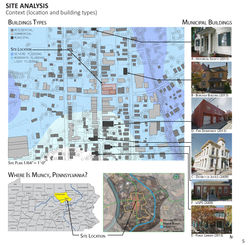 Site Analysis |  Site Analysis |  Site Map |
|---|---|---|
 Site Elevations and Sections |
For this project, my class was asked by the borough of Muncy, PA to renovate an existing historic structure as a center of resiliency. Given these goals, the result of this renovation for my group was the creation of the Haven Command Center, acting as a haven in times of crisis and an educational facility on a daily basis. The most central factor in the repurpose and design of this structure was the town’s troubled history of flooding and the subsequent damages caused under such disaster.
In response to this, my group designed a safe haven to provide shelter, protection and safety for the local community if displacement occurs during times of severe flooding. It also acts as a command center and a base of operations for officials, emergency personnel and government workers to occupy and function during times of crisis. An educational facility houses a library, historical exhibition, research area and archive to store and display historical resources for everyday use.
In the event of a major flood, we purposely distributed the programmatic features of the structure in order to best protect the building from damages caused by flooding. The archive, historical exhibition, research and command center were placed well above base flood elevation, allowing the building to function in both day-to-day and emergency situations. What falls below base flood elevation is constructed with waterproofed materials and ramping to maintain access to all upper levels of the building.
 Exterior Corner Underneath Bridge | 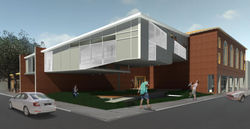 Everyday Exterior | 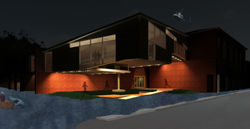 Emergency Exterior |
|---|---|---|
 Theater Towards Command Center |  Bridge Interior View |  Archive Exterior View |
 Archive Interior View |  Command Center View |  Farmer's Market |
 Exterior Night |  Exterior Opera House |
Resiliency is the ability to evolve and withstand ever changing conditions such as a natural disaster. The Haven Command Center demonstrates resiliency through the structure and program of the building. The Muncy historical society and borough offices were directly affected by flooding and suffered severe damage in 2011. My group decided to relocate these organizations directly into the project, becoming an essential part of the building.
Our scheme maintains two existing historical structures on the site, the Muncy Opera House and Ritz Theatre, as the anchoring support that hold up the new construction. This cantilevering bridge over the corner lot restores the street line where an auto shop once stood. Underneath this bridge, the designed landscape addresses flooding and contamination issues with concrete capping and bioremediation to help clean soil and groundwater. A cistern underneath the bridge's structural column collects rainwater and becomes a ground source for the HVAC system.
 Section thru Bridge and Archive |  Ground Floor Plan |  Section thru Ramp & Command Center |
|---|---|---|
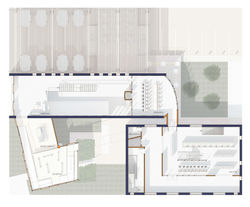 Second Floor Plan |  Section 1 | 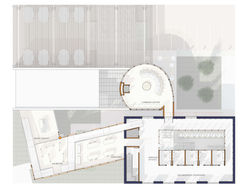 Third Floor Plan |
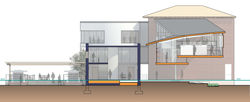 Section thru Entrance Ramp & Bridge |
In the center of the existing opera house sits the archive, a controlled environment that holds historic documents, models, and other important information. As time goes on, community members can bring their own materials to the archive that they would like to preserve, making it a continually evolving space. Government officials do not have a proper place to gather in Muncy, so my group created a command center and base of operations on top of the existing Ritz theater where officials would gather in times of emergency. The main entrance incorporates a long ramp to elevate people off of the ground as quickly as possible, as well as a boat dock to use during floods. The theater becomes part of a circulation hub directly connected to the bridge and existing opera house. Circulation extends in a loop throughout the site, allowing users quick access to important programmatic spaces.
Studying if this project was structurally feasible, we used a box truss system spanning over the corner lot using the existing buildings as anchors. Later in the design process, a column was added at the intersection of the trusses for rigidity in addition to functioning as a storm drain pipe into the cistern below ground. To help encourage community growth, we added a farmer’s market on top of the existing back parking lot. Porous ground materials aid with drainage in the event of a flood.
 Site Sustainability |  Energy Systems | 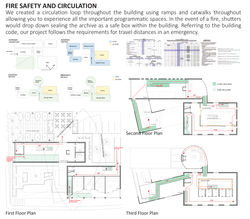 Fire Safety |
|---|---|---|
 Building Envelope |  Daylighting |  Model |
 Model |  Structure |
This project was completed by Bernardo Almeida, Andrew Novillo, and Marlene Sharp.